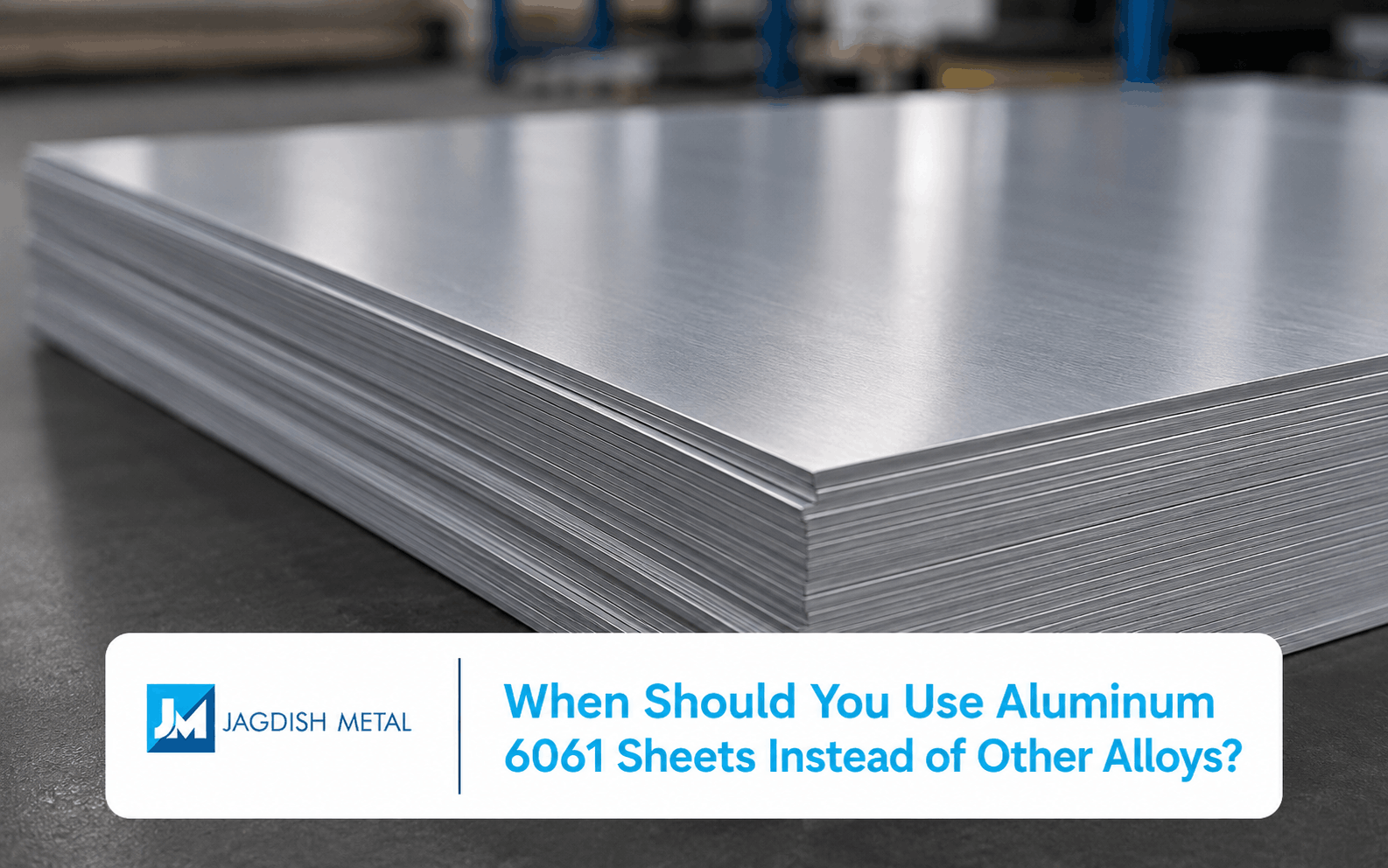
A bracket that corrodes in two years costs more than the alloy ever saved on the invoice. That’s the calculation behind every aluminium grade decision, and it’s why 6061 sheets show up in so many bills of material across aerospace, construction, and marine work. The alloy balances strength, weldability, and corrosion resistance better than most competing grades manage at once. Get the grade wrong and you either overpay for properties the part never needs, or underbuild and watch it fail early. Fabricators across India lean on suppliers like Jagdish Metal because certified, traceable sheet stock removes that guesswork.
Understanding Aluminium 6061 Sheets
Magnesium and silicon drive the alloy’s behavior, sitting at roughly 0.8 to 1.2% and 0.4 to 0.8% respectively. That combination makes 6061 heat-treatable. Solution heat treatment followed by artificial aging pushes the tensile strength to around 310 MPa and yields strength near 276 MPa in the T6 condition, comfortably ahead of non-heat-treatable grades such as 5052 or 3003.
Most mills stock 6061 in T6 and T651 temper, though annealed O-condition sheet stays available for shops that need to form first and harden later. Thickness ranges from 0.5mm up to over 100mm. Aluminium 6061 Sheets are available in a wide range of tempers and thicknesses, making them one of the most frequently specified aluminium grades across diverse industries.
Key Features That Set 6061 Apart
The oxide layer that forms naturally on 6061 blocks most atmospheric corrosion without any coating step. Density runs at one-third of steel, so structural weight drops while load capacity holds. Machinability beats 7075 and 2024 by a wide margin, and standard TIG or MIG equipment welds it without specialized filler. Heat treatment lets a fabricator tune final strength after forming rather than locking it upfront. Anodizing and powder coating both work well for the surface finish. None of this degrades quickly. Outdoor structures in 6061 commonly run two to three decades before corrosion becomes a maintenance concern.
When Should You Use Aluminum 6061 Sheets?
Load-bearing frames, platforms, and structural brackets need 6061 when the part needs T6-level strength without steel’s weight penalty.
Outdoor equipment, roofing, and moisture-exposed enclosures are another clear case. Oxidation resistance here beats uncoated mild steel by a wide margin, and that directly cuts maintenance frequency.
Weight matters most in automotive panels, transport trailers, and aerospace mobility components, where every bit of weight removed improves fuel economy or payload.
CNC shops reach for 6061 because it cuts cleanly and drills without chewing through tooling, even across long production runs with tight tolerances.
Strong welded joints are a priority in construction and fabrication work, and 6061 pairs reliably with 4043 or 5356 filler to hold most of the base metal’s strength through the joint.
Budget is also an important factor. When a project needs solid mid-to-high performance but can’t justify 7075 or 2024 pricing, 6061 closes that gap without giving up much in practical terms.
Aluminium 6061 vs Other Aluminium Alloys
Marine splash zones favor 5052 over 6061, and deep-drawn parts form better in 5052 too, but the trade-off is real: 5052 cannot be heat-treated up to 6061’s strength. Fuel tanks and sheet metal enclosures go to 5052; structural brackets go to 6061.
The strength of 7075 reaches almost double 6061’s tensile rating and dominates aerospace spars and high-stress fittings as a result. What 7075 gives up is machinability and price, both of which run worse than 6061. Use 7075 for the applications that genuinely need that strength.
Fatigue resistance is where 2024 wins, and that’s why aircraft skins still specify it decades after introduction. Corrosion resistance flips the comparison, though. 2024 needs cladding or it pits faster than 6061 will, and the maintenance burden grows accordingly. Ground-based structures favor 6061 for exactly this reason.
Saltwater pitting resistance puts 5083 ahead in shipbuilding and hull plating, where its weldability also holds up under repeated marine exposure. Outside marine environments, 6061 remains the more economical pick without losing meaningful weldability.
Industries That Rely on Aluminium 6061 Sheets
Aerospace brackets, automotive chassis components, construction framing, marine fittings above the waterline, electronics enclosures, and industrial machinery housings all draw on the same combination of strength, corrosion resistance, and easy machining.
Advantages and Limitations
Few wrought alloys cover as many industries as 6061 does. It ships in more tempers and sizes, demands less maintenance than uncoated steel, and fabricates with fewer process restrictions than most alternatives. However, three limitations are worth knowing before specifying it. Extreme marine immersion still favors 5083’s pitting resistance. Aerospace components under sustained high stress get better fatigue and ultimate strength numbers from 7075 or 2024. Deep-draw forming goes further in 5052 before the metal cracks. None of these limitations rule out 6061, but they do mark where another grade earns its place.
Factors to Weigh Before Selecting an Alloy
Environmental exposure determines whether corrosion resistance or coatings matter most. Mechanical load sets the strength, temper, and thickness needed to prevent bending or failure. Fabrication method affects whether the alloy must weld, machine, bend, or heat-treat cleanly. Lifecycle budget looks beyond purchase price to maintenance, downtime, and replacement costs. Weight target matters when lighter parts improve payload, fuel economy, or handling. The maintenance schedule decides how much inspection, cleaning, or surface protection the part can realistically receive. Considering all six prevents overpaying for unused performance or choosing material that wears out too soon or fails under real operating conditions.
Choosing the Right Supplier
Certifications and inspection reports separate a dependable supplier from a risky one. Jagdish Metal holds ISO 9001:2008 and OHSAS 18001:2007 certification, sources raw material from certified stockists, and runs quality checks at multiple production stages. Third-party inspection is available through agencies including Metallurgical & Engineering Consultants (India) Ltd. That documentation trail matters most when a project’s safety case depends on knowing exactly where the material came from.
Conclusion
Strength, weldability, corrosion resistance, and machinability rarely come together this cleanly without aerospace-grade pricing, which is why 6061 remains the default structural choice for so many projects. Marine immersion still calls for 5083. Peak fatigue resistance still belongs to 2024. Extreme formability still goes to 5052. Matching the alloy to the actual application, rather than reaching for whatever’s on the shelf, protects both budget and working life. Jagdish Metal supplies the certified sheet stock that backs up that decision, grade by grade.