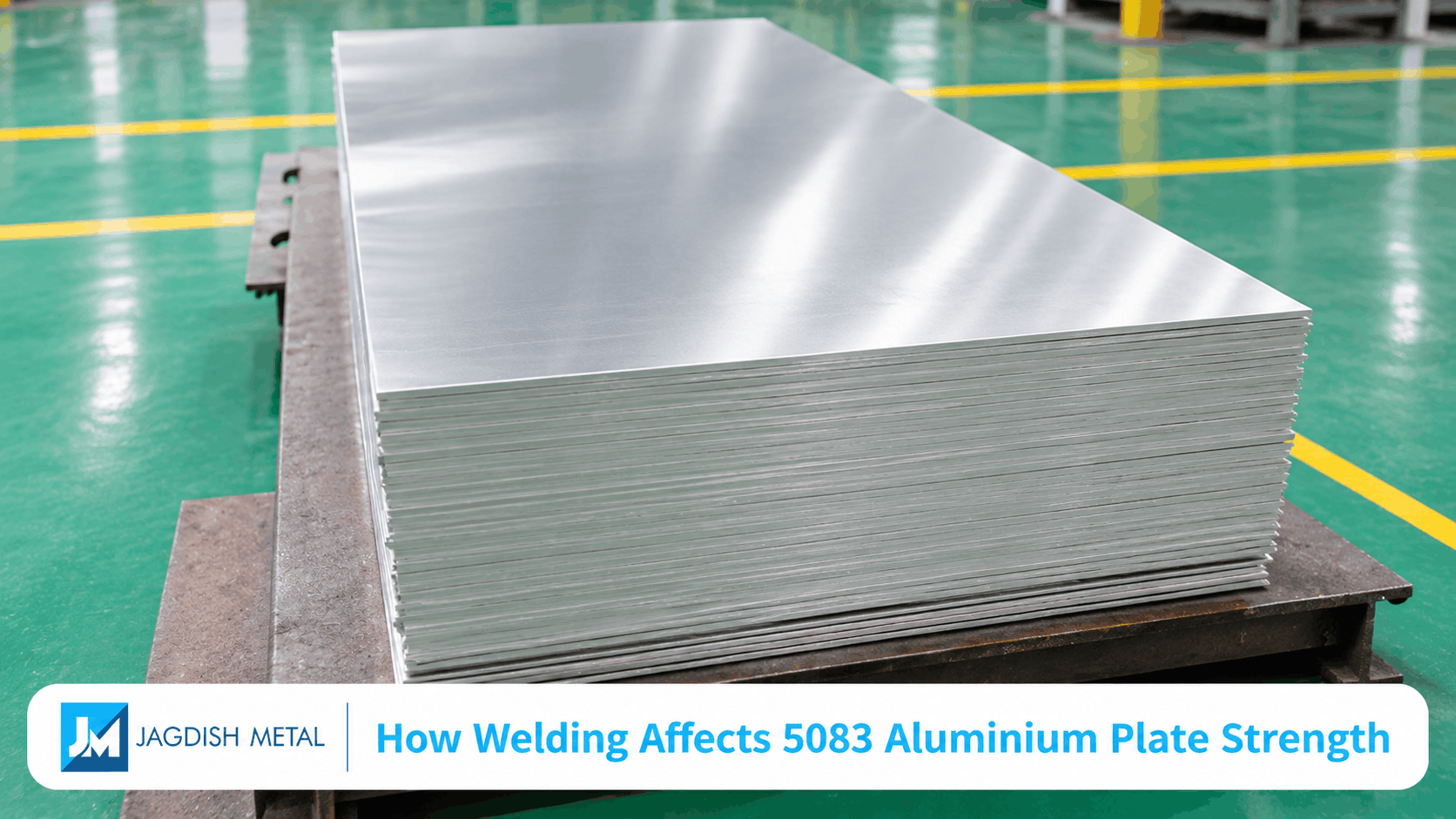
Welding reduces the strength of 5083 aluminium plate locally, around the joint and inside the heat-affected zone, while the rest of the plate keeps its original condition. 5083 is a non-heat-treatable aluminium-magnesium alloy recognised for high strength, resistance to seawater corrosion, and excellent weldability. Fabricators specify it for marine hulls, tankers, rail and road transport bodies, pressure vessels, and cryogenic equipment. Arc heat changes the mechanical state of the metal near the fusion line, and sound design accounts for that change rather than ignoring it.
Understanding 5083 Aluminium Plate Properties
5083 contains 4.0 to 4.9 percent magnesium, with small manganese and chromium additions that refine grain structure. Magnesium dissolves into the aluminium matrix and raises strength through solid solution strengthening. Cold rolling adds more through strain hardening. The alloy gains nothing from solution treatment or ageing, so the familiar quench and age route used for 6000 and 7000 series alloys does not apply here. Tensile strength in H116 condition ranges from 305 to 385 MPa. Four tempers appear most often in fabrication: O for the annealed condition, H111 for light strain hardening, and the stabilised H116 and H321 tempers specified where exfoliation resistance governs. Shipbuilders ordering 5083 aluminium plate for hulls and superstructures work mainly with the last two.
How Welding Affects the Strength of 5083 Aluminium Plate
Welding softens the metal beside the joint because arc heat removes the strain hardening that gives H temper plate its additional strength. The heat-affected zone extends a few millimetres either side of the fusion line. Within that band, the dislocation structure built up during cold rolling recovers, and local strength falls towards annealed values. Plate supplied in O temper shows far less change, since it carries no strain hardening to lose. Past the heat-affected zone, the base material stays untouched. A welded joint in 5083 still carries substantial load: design codes commonly rate as-welded tensile strength near 275 MPa. Engineers size the joint against those welded figures rather than the properties printed for the original temper.
Factors That Influence Strength After Welding
Five variables decide how much strength a finished joint retains.
- Original temper. Strain hardened tempers such as H116 and H321 soften locally during welding. Annealed plate changes least.
- Heat input. Excessive heat widens the affected band and lowers properties across a larger area. Controlled current and travel speed keep it narrow.
- Welding process. MIG handles thicker sections and faster deposition rates, while TIG offers finer control on plate below 6 mm.
- Filler material. 5183 and 5356 are the standard choices, selected against the qualified welding procedure and the design requirement.
- Material preparation. Clean, dry, oxide-free surfaces cut porosity and keep contamination out of the weld pool.
How to Maintain Strength and Weld Quality
Control of heat input preserves more of the surrounding plate condition than any other single measure. Set current, voltage, and travel speed from a qualified welding procedure rather than by operator judgement. Select the filler alloy against service conditions, since 5183 and 5356 differ in deposited strength and corrosion behaviour. Degrease the joint area, then remove the oxide film with a dedicated stainless wire brush shortly before the arc is struck. Inspect completed welds visually, and apply radiography or dye penetrant testing where the governing code calls for it. Assess the finished structure using mechanical properties valid for the welded condition, not the values recorded on the original plate certificate.
Weight Calculation and Quality Checks for 5083 Aluminium Plates
Accurate weight estimates keep material planning, costing, and handling arrangements realistic before fabrication starts. 5083 has a density of 2.66 g/cm³, so weight follows directly from length, width, and thickness. An aluminium weight calculator converts those dimensions into a working figure within seconds. Confirm grade, temper, dimensions, and specification against the mill test certificate as well, and review the applicable quality standards and inspection requirements before cutting begins.
Conclusion
Welding lowers the strength of 5083 aluminium plate locally, and strain hardened tempers show the clearest drop inside the heat-affected zone. Controlled heat input, correct filler selection, qualified procedures, and documented inspection keep that reduction predictable and manageable. Jagdish Metal supplies aluminium plates, sheets, coils, bars, and related products across standard grades and tempers.